Until now, European packaging legislation has been based on Directive 94/62/EC, which governed the prevention, collection and recycling of packaging waste for almost three decades. Over time, however, it became clear that the Directive could neither respond adequately to new environmental challenges nor ensure uniform rules across the European market. As part of the European Green Deal and the Circular Economy Action Plan, the European Commission therefore developed a new legislative framework, resulting in Regulation (EU) 2025/40 on packaging and packaging waste (PPWR).
The PPWR represents much more than another amendment to packaging legislation. It introduces a new approach to the responsibilities of individual actors in the supply chain and strengthens the link between how packaging is designed and placed on the market and the environmental impact of its use. Above all, the fundamental change in the rules lies in the new definition of the entity responsible for packaging.
In this context, particular importance attaches to the question of who qualifies as a packaging producer under the new legislation and which entity must be responsible for fulfilling extended producer responsibility obligations. This is more than a terminological or formal change. Correctly identifying the producer directly affects record-keeping for packaging placed on the market, the reporting of packaging quantities, the financing of separate collection and the overall operation of the extended producer responsibility system.
One of the most widely discussed changes currently being considered by Slovak businesses, producer responsibility organisations and the Ministry of Environment of the Slovak Republic in connection with the application of the PPWR concerns neither new requirements for packaging materials nor their labelling. It is the answer to a seemingly simple question: “Who actually is the packaging producer?”
Let us therefore take a closer look at who is considered a packaging producer under the PPWR and what this means in practice.
One of the most significant changes concerns empty transport packaging, service packaging and primary production packaging.
For this category of packaging, the producer will now, in most cases, be the manufacturer of the empty packaging itself—the entity that physically manufactures it. In practice, for unbranded packaging in this category manufactured and supplied within Slovakia, EPR obligations will no longer be fulfilled by the business that purchases the packaging and subsequently uses it to pack its product. Responsibility moves one step upstream in the supply chain, to the entity that manufactured the packaging in Slovakia and first made it available on the Slovak market.
The situation is different if you commission the manufacture of empty transport packaging, service packaging or primary production packaging bearing your own trademark. In that case, you will be the producer for EPR purposes. This does not apply, however, if you qualify as a micro-enterprise¹: in that case, the producer bearing EPR responsibility will be the entity from which you commissioned the manufacture of the packaging.
For this category of packaging, you will also be considered the producer for EPR purposes if you specify particular technical or design requirements to the packaging manufacturer, such as specific die-cuts or packaging features, a required recycled material content or other special parameters. This interpretation is based on the European Commission’s publication “Packaging and Packaging Waste Regulation (PPWR) – Frequently Asked Questions, 2nd edition, August 2026”.
I would emphasise that the situation described concerns packaging both manufactured and supplied within Slovakia.
If you purchase unbranded empty transport packaging, service packaging or primary production packaging from abroad, you are its producer for EPR purposes. This applies both where you use the empty packaging acquired from abroad to pack your own products and where you resell or supply it unchanged in Slovakia to other businesses that subsequently use it for packaging.
Goods supplied from abroad
For packaged goods supplied from abroad, identifying the producer requires a distinction between goods intended for further distribution in Slovakia and goods supplied directly to an end user.
If packaged goods from abroad are supplied to a Slovak company that subsequently distributes them further on the Slovak market, the producer for the purposes of fulfilling extended producer responsibility (EPR) obligations is generally that Slovak company, which first made the goods available on the Slovak market and subsequently distributes them further within that market.
The situation is different where a foreign supplier supplies packaged goods directly to an end user in Slovakia. In that case, the foreign supplier is generally considered the producer for EPR purposes. An end user need not be a consumer: it may also be a professional end user, such as a company that uses the product for its own needs or in production and does not distribute it further.
The decisive factor is therefore not merely that the goods come from abroad, but, above all, what happens to them after delivery to Slovakia: whether they are supplied to their end user or continue along the distribution chain.
Example 1 Goods intended for further distribution
A Czech manufacturer supplies packaged products to a Slovak wholesaler, which subsequently sells them to other traders in Slovakia.
The producer for EPR purposes is generally the Slovak wholesaler, because it is the first Slovak company in the distribution chain and distributes the goods further on the Slovak market.
Example 2 Goods supplied directly to an end user
A German supplier supplies a packaged product directly to a Slovak manufacturing company, which uses it in its operations for its own needs and does not resell or distribute it further.
The producer for EPR purposes is the German supplier, as the Slovak company is a professional end user in this case.
If you purchase packaged goods from abroad and are their end user, we recommend informing your foreign supplier of this fact. The supplier should then arrange to fulfil the EPR obligations of a packaging producer in the Slovak Republic.
Goods supplied from Slovakia to other countries
For packaged goods supplied from Slovakia to other countries, the situation is the reverse of that for goods supplied from abroad. If a Slovak company supplies packaged goods to the market of another Member State, the producer and the entity bearing EPR obligations must be identified in relation to the market of the destination country.
Here, too, it is important to distinguish between goods supplied by the Slovak company to a foreign company for further distribution and goods supplied directly to an end user abroad.
If a Slovak company supplies a packaged product to a Czech distributor, for example, which subsequently resells it on the Czech market, the producer for EPR purposes should generally be the first Czech company that distributes the packaged product further on that market.
The situation is different where a Slovak company supplies a packaged product directly to an end user in another Member State. Since there is no local distributor between the Slovak supplier and the foreign end user, the producer obligations relating to the packaging apply directly to the Slovak company as the foreign supplier. The Slovak company must also arrange to fulfil its EPR obligations in the relevant Member State, for example in the Czech Republic through the relevant producer responsibility organisation, in accordance with the rules applicable in that country.
Again, an end user may be not only a consumer but also a professional end user, such as a business that uses the purchased product for its own needs or in its operations and does not distribute it further.
The decisive factor is therefore not merely that the goods leave Slovakia. What matters is to whom they are supplied in the destination country and whether they continue along the distribution chain after delivery.
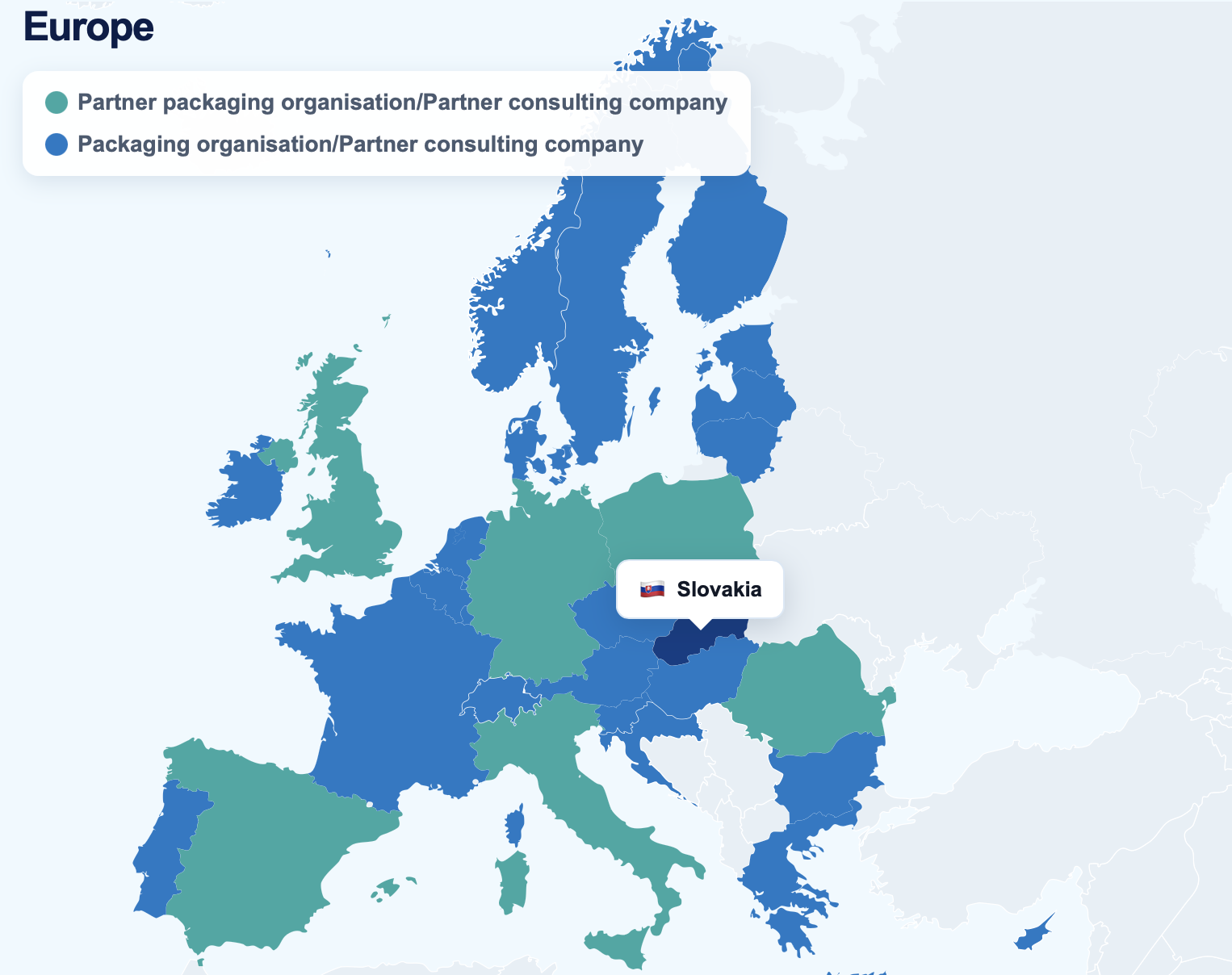
NATUR-PACK has prepared a practical interactive map to help you easily find partner organisations in individual EU Member States ( https://www.naturpack.sk/en/services/producers/partner-organisations-in-europe/).
What is meant by an end user
An end user is a person or company at which the distribution chain for a particular product ends. They acquire the product for their own consumption or professional use and do not distribute it further as a product in the form in which it was supplied.
An end user may therefore be:
- a consumer, such as an individual purchasing a product for personal consumption;
- a professional end user, meaning a business operator or company purchasing a product for its business activities and neither reselling nor distributing it further in the form in which it was supplied.
Sales packaging and grouped packaging
For sales packaging and grouped packaging, the packaging producer for the purposes of fulfilling extended producer responsibility (EPR) obligations is generally the packer or filler: the company that packs a product or fills it into packaging and subsequently makes it available on the market in that packaging.
This means that the manufacturer of empty sales packaging or grouped packaging does not, as a rule, become the packaging producer for EPR purposes merely by manufacturing that packaging. Responsibility lies with the company that uses the packaging to pack or fill a product and subsequently makes the packaged product available on the market.
If you have a product manufactured and packaged by another company but place it on the market under your own name or trademark, you are considered the producer of the sales packaging or grouped packaging for EPR purposes. An exception applies if you are a micro-enterprise¹. In that case, the producer for EPR purposes is the company that packed the product or filled it into the packaging. This applies provided that both the company commissioning the manufacture and packaging of the product and the company packing or filling it are established in the Slovak Republic.
Repacking goods
If a company is the first entity in Slovakia to place goods acquired from abroad on the Slovak market, and also unpacks and subsequently repacks those goods without being their end user, that company is generally considered the packaging producer for EPR purposes, unless another producer has been identified as responsible for fulfilling the EPR obligations.
What does the change in producer status mean for packaging records and the financing of EPR and separate collection
The change in the definition of producer under the PPWR goes beyond identifying the entity required to fulfil EPR obligations. It also changes which entity records and reports particular quantities of packaging. From 12 August 2026, some companies may therefore see a decrease in their recorded packaging quantities, because they will no longer have producer status for part of their packaging flows. Conversely, other companies may see their quantities increase or become subject to record-keeping and EPR obligations for the first time. This shift in responsibility is precisely what the current guidance from the Ministry of Environment of the Slovak Republic highlights.
Specific record-keeping considerations for 2026
Since the definition of producer changed during the calendar year, with effect from 12 August 2026, records will need to take account of two regimes. The current guidance from the Ministry of Environment of the Slovak Republic states that data must be obtained to enable a comparison between packaging quantities recorded under the rules in force before the PPWR became applicable and those recorded after it became applicable.
This is more than an administrative matter. Data on packaging quantities reported by individual producers are an important input into the EPR system. If the new definition transfers producer status from one entity to another, responsibility for the corresponding quantity of packaging and for fulfilling EPR obligations transfers with it.
What might this mean for the financing of the EPR system
This brings us to one of the most important practical consequences of the change.
The new definition does not, in itself, mean that more or less packaging will be placed on the Slovak market. It does, however, change who bears EPR responsibility for particular packaging and through whom those quantities will be reported and financed within the system.
For example, a quantity of transport packaging previously reported by a packer may now be reported by its Slovak manufacturer. Similarly, for packaged goods supplied from abroad for further distribution, the new rules assign responsibility to the Slovak recipient that distributes them further. By contrast, for direct cross-border supplies to an end user, EPR responsibility lies with the foreign supplier.
This may lead to shifts in reported quantities between individual producers and, subsequently, between the producer responsibility organisations through which producers fulfil their statutory obligations. This may, in turn, have financial implications for individual producers and producer responsibility organisations. The actual extent of the financial impact can, however, be assessed objectively only on the basis of actual record-keeping data.
What about separate collection in Slovakia
This is precisely where it becomes clear why correctly identifying the producer is more than a legislative formality.
After use, packaging may become waste regardless of which entity was identified as its producer under the PPWR. From the system’s perspective, it is therefore important that quantities of packaging entering consumption in Slovakia and potentially subsequently entering the waste stream are also correctly accounted for within the EPR system.
If legal responsibility for certain packaging shifts between entities, record-keeping and the fulfilment of obligations must be adjusted accordingly. It will be essential to prevent both the same quantity of packaging being reported twice and the opposite situation, in which it is not reported at all because the producer has been incorrectly identified.
For this reason, data quality, accurate mapping of supply flows and the exchange of information between suppliers and customers will be particularly important in the period ahead. The Ministry of Environment of the Slovak Republic expressly identifies the comparison of data before and after the change in the definition of producer as necessary to enable the system for fulfilling statutory obligations to adapt smoothly to the change.
A change that may initially appear to be an amendment to a single definition therefore actually affects record-keeping, reporting, contractual relationships, the financing of the EPR system and the stability of separate collection in Slovak towns and municipalities.
The system’s operation will therefore depend on more than our ability to identify the producer correctly. It will be equally important to ensure that every item of packaging placed on the Slovak market is linked to a clearly identified entity that assumes responsibility for it and ensures that the EPR obligations are fulfilled.
If the EPR system and the associated separate collection system are to continue operating reliably after the rules change, the risk of certain packaging quantities falling outside the records and the financing system must be minimised. This must not happen simply because the entity to which responsibility has transferred under the new rules is unaware of its obligation or fails to respond in time.
In my view, it is therefore essential that all stakeholders address the new obligations arising from the PPWR as soon as possible and with the utmost responsibility.
I consider active communication between Slovak companies and their foreign trading partners to be one of the most important tasks in the period ahead. This is particularly important where a Slovak company purchases packaged goods from abroad as their end user. As noted above, in such a case the Slovak company should inform its foreign supplier that supplying packaged goods directly to an end user in Slovakia gives rise to packaging producer obligations for EPR purposes.
The information in this article is based on the materials currently available and the current interpretation of the PPWR. As interpretation and implementation practice may continue to evolve, the article is for information purposes only and does not constitute a legally binding interpretation or individual legal advice.
Author
Mgr. Roman Zvara, Environmental Specialist at NATUR-PACK, a producer responsibility organisation
Sources
- Regulation (EU) 2025/40 of the European Parliament and of the Council of 19 December 2024 on packaging and packaging waste, amending Regulation (EU) 2019/1020 and Directive (EU) 2019/904, and repealing Directive 94/62/EC
- https://environment.ec.europa.eu/topics/waste-and-recycling/packaging-waste_en?utm_source.com
- Packaging and Packaging Waste Regulation (PPWR) – Frequently Asked Questions, 2nd edition, August 2026.
- Guidance of the Ministry of Environment of the Slovak Republic on the practical application of the definition of packaging producer under Regulation (EU) 2025/40 of the European Parliament and of the Council on packaging and packaging waste, amending Regulation (EU) 2019/1020 and Directive (EU) 2019/904, and repealing Directive 94/62/EC (hereinafter the “Packaging Regulation”), and on the submission of the data required from packaging producers in connection with the change in the definition of packaging producer for the specified period.
¹ Commission Recommendation 2003/361/EC of 6 May 2003 concerning the definition of micro, small and medium-sized enterprises (OJ L 124, 20.5.2003, p. 36).