Extended Producer Responsibility: one of the pillars of successful waste sorting in Slovakia
Extended Producer Responsibility (EPR) is among the key tools that have enabled Slovakia to significantly improve its results in the sorting and recycling of municipal waste in recent years. This is also confirmed by the Waste Management Strategy of the Slovak Republic through 2035, which was approved yesterday by the Government of the Slovak Republic.
EPR as a system that delivers measurable results
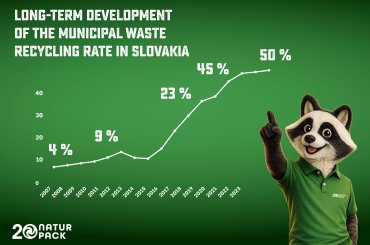
The Strategy clearly states that a substantial increase in the municipal waste recycling rate occurred from 2016 onward, i.e. from the period when the extended producer responsibility system for packaging and non-packaging products was fully implemented in Slovakia.
Over the past decade, the municipal waste recycling rate has increased from approximately 10% to more than 50%, bringing Slovakia to the European Union average. The document also notes that EPR, mandatory waste sorting, and the gradual increase in landfill fees are among the main factors behind this positive development.
“The Waste Management Strategy clearly confirms what we have seen in practice for years – extended producer responsibility works. It is a system that ensures the financing of separate collection, brings stability to municipalities, and genuinely improves recycling results in Slovakia,” says Michal Sebíň, CEO of the organization NATUR-PACK.
Less landfilling, more recycling
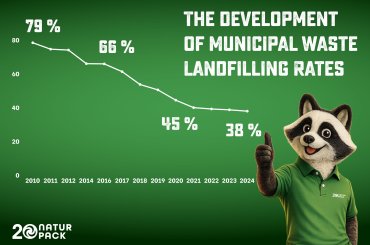
A functioning EPR system has also resulted in a significant decline in the landfilling of municipal waste. While more than 80% of municipal waste ended up in landfills in 2010, this figure dropped to 39% in 2023 and to just 38% in 2024.
The Strategy also confirms that extended producer responsibility is directly linked to the development of separate collection in municipalities, as the financing of the collection, transport, and recovery of selected waste streams is ensured by producers through producer responsibility organizations.
A strategic pillar through 2035
Extended producer responsibility is not perceived in the Strategy merely as a tool of the past, but also as an essential pillar for the future. The document defines it as a standalone key area of waste management and envisages its further strengthening in meeting the targets through 2035—particularly in the areas of higher recycling rates, infrastructure development, and support for the circular economy.
“If Slovakia is to meet its ambitious targets by 2035, it simply will not be possible without strong and stable EPR. Through producer responsibility organizations, producers assume responsibility and finance a system that delivers real environmental benefits,” adds Michal Sebíň.
Proof that the system works
The Waste Management Strategy of the Slovak Republic through 2035 thus confirms that extended producer responsibility is a functional, effective, and indispensable system, without which Slovakia would not have achieved its current level of waste sorting and recycling. Thanks in part to him, Slovakia has a solid foundation for the further development of the circular economy in the coming period.
The full document is available at the following link: https://www.minzp.sk/odpady/poh/soh-do-roku-2035.html