As recycling rates increase, what dominated Slovakia for many years – landfilling – must logically decline. And in recent years, significant progress has been visible in this area.
As recently as 2010, approximately 79% of municipal waste ended up in landfills. Slovakia ranked among the EU countries with the highest landfilling rates. A large share of waste was disposed of without utilizing its material potential.
The situation began to change through gradual systemic reforms, the expansion of separate collection for all components of municipal waste, and a major reform of financing for the separate collection of paper, plastics, glass, composite and metal packaging after 2016. At that time, producers, through Producer Responsibility Organizations (PROs), assumed full financial responsibility for the separate collection of these waste streams, enabling the system to stabilize and further develop across municipalities throughout Slovakia.
The results are measurable:
In 2016, the landfilling rate was approximately 66%,
In 2020, it decreased to 45%,
In 2024, it stands at approximately 38%.
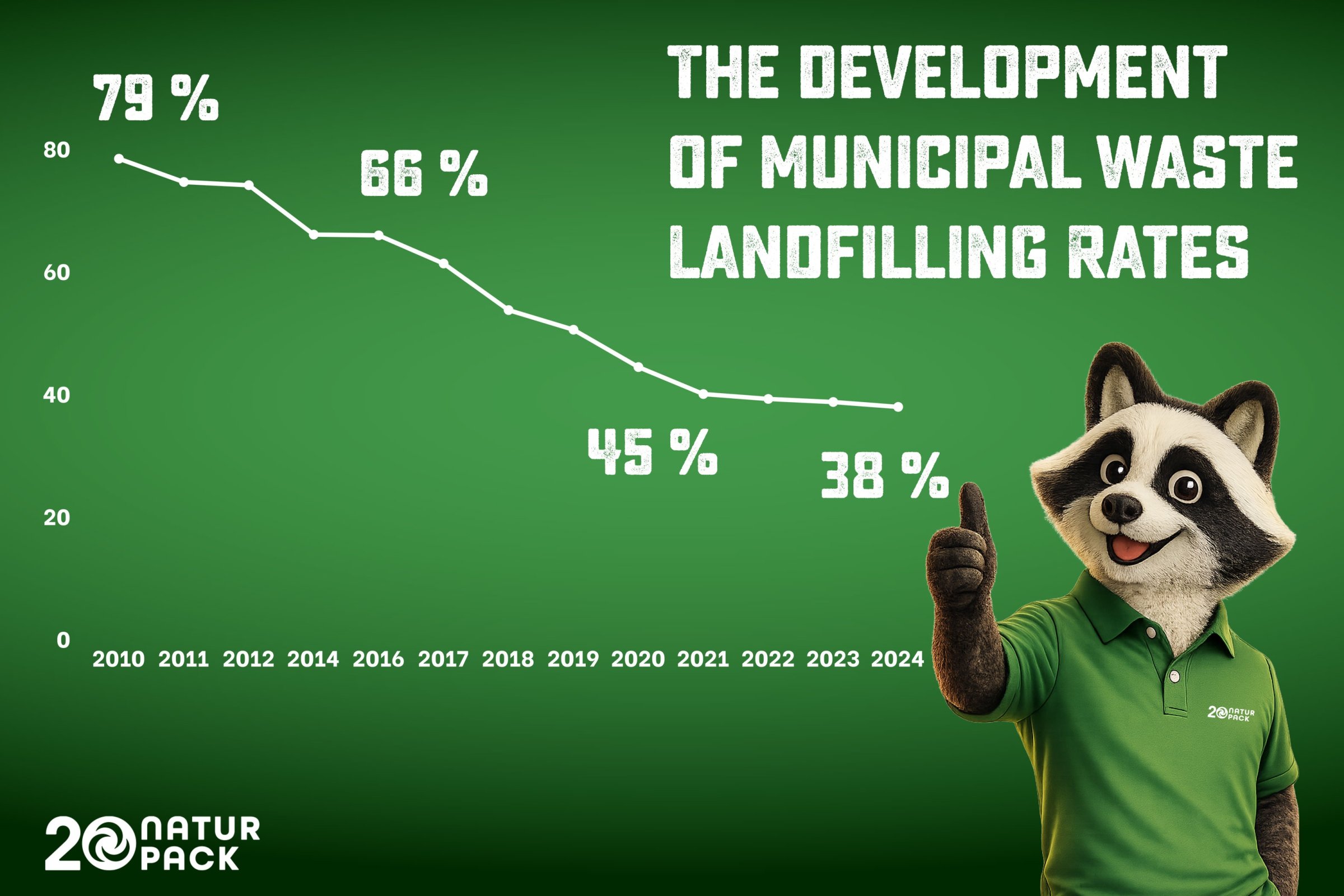
In less than 15 years, Slovakia has reduced the share of landfilled municipal waste by nearly half.
This is not just a statistical improvement. Each percentage point represents thousands of tonnes of waste diverted from landfills to recycling or other recovery operations. Less waste in landfills means lower environmental burdens, fewer greenhouse gas emissions, and more efficient use of resources.
The trend is clear – Slovakia is gradually moving away from the linear model of “produce – use – dispose” and towards a circular economy.
The decline in landfilling is direct evidence that the system of separate collection for all components of municipal waste is working and delivering tangible results. The color-coded container system – covering paper, plastics, glass, composite and metal packaging, combined with continuous public education – financed by producers since 2016, is an essential part of this progress. Although the goal has not yet been fully achieved, the direction is clear.
From a country once ranked among the lowest performers in Europe, Slovakia is steadily becoming a country capable of systematically reducing its dependence on landfills.
This progress is the result of cooperation between municipalities, producers, and above all citizens – because without them, it simply would not be possible.
#WasteSortingInNumbers #NATURPACK #Landfilling